



Borosilicate glass is a material that is resistant to strong chemicals and big temperature differences
Borosilicate glass, Pyrex, Tempax, Simax and Duran. Basically the same product using a different name. It has many uses within industry and business because of the ability to function I high temperature environments and can withstand harsh chemicals. In virtually alle modern laboratories it is the preferred type of glass for the laboratory equipment. Mirit Glas supplies borosilicate glass according to individual needs.
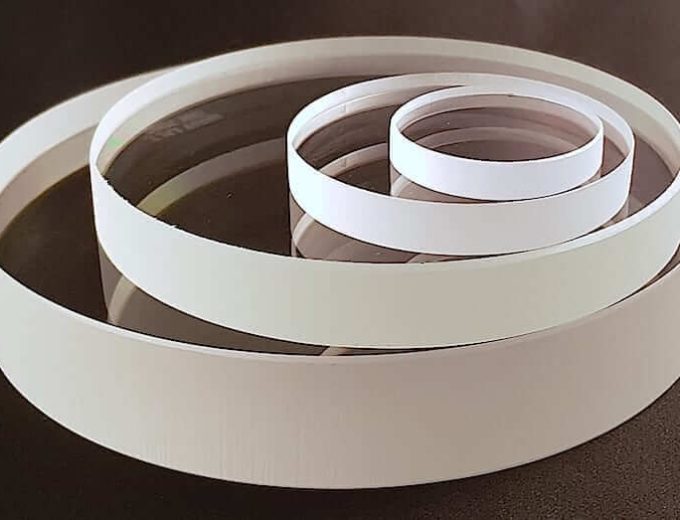
We are stock-bearing in sheets of 0.7mm – 25 mm and in glass tubes from ø3 mm – ø400 mm. As borosilicate glass is mainly used for technical applications where specific thickness is required borosilicate glass is available in more thicknesses than ordinary soda lime glass
We also offer borosilicate glass with different coating if needed.
Contact Mirit Glas to hear more about the glass’s special properties and how it can be a good solution for you.

TYPICAL USE
Borosilicate glass has many usages – from sight glass and laboratory equipment to lighting glass and various industrial items. But as it is a versatile glass it is also seen used very different usages like in farming solutions and for vintage gas station pumps.
Due to the low coefficient of expansion borosilicate glass can withstand large temperature differences making it particularly suitable in high temperature environments. The high chemical resistance also makes it obvious to use in connection with aggressive chemicals.
Special properties
Borosilicate glass is also known by the names Pyrex, Tempax, Simax and Duran, and in the case of glass in sheets, it is frequently referred to as borofloat.
What makes borosilicate glass special is its ability to endure high temperature differences and its durability against aggressive chemicals.
The glass has a unique corrosion resistance and remains neutral – even when in contact with very aggressive chemicals. Only a few chemicals can cause noticeable corrosion in the surface of borosilicate glass. This applies, for example, to hydrofluoric acid, concentrated phosphoric acid and strong caustic solutions at high temperatures (at room temperature it can withstand caustic solution concentrations of up to 30%).
The glass has a fine transmission of more than 90% from 380 nm (visible light) to 2000 nm (infrared light).
Borosilicate glass in many variations
At Mirit Glas, we can process borosilicate glass in the following ways:
- Customized shape, holes and notch
- Edging – from rough to polished finish
- Sandblasting
- UV gluing
- Paint
- Screen printing
- Thermal tempering. Tempering provides greater strength and safety in the event of breakage.
- Bending
- Lamination
- Coating. It is possible to influence the transmission and reflection of the glass with different surface treatments (coating). This can, for example, switch off the “cold” light or minimize the reflections at a certain wavelength at a defined angle.
It is not possible to chemically temper Borosilicate glass because the sodium content is too low. Feel free to contact us for more information.
What is borosilicate glass?
Glass is not just glass. There are several hundred different types, and at Mirit Glas we are the experts who can help you find and process the right glass for your specific purpose and needs.
Borosilicate glass is a versatile technical glass. Mainly because it has properties that make it useful in various technical processes.
Typical an educational institution, an industrial company or a research facility in need of chemical glassware and other glassware for laboratory use, would look for the properties contained in borosilicates. Lab glass like glass flasks, beaker glasses and testing tubes made of borosilicate glass are the standard choice in many modern laboratories, because a glass tube, vials glass or petri dishes glass made of borosilicate glass has unique properties, that facilitates the needs of modern science.
The glass type has been around since the late 19th century, were it was invented by the German glass pioneer Otto Schott, who is also known for having worked closely together with two other german glass pioneers, Carl Zeiss and Dr. Ernst Abbe. As Otto Schott invented the glass in the city of Jena it was for many years also known as Jena glass.
The essence of Borosilicate glass is the special molecular composition that provides the glass with various useful properties. Not only as glassware (Pyrex) in the oven – but also for business and industrial purposes, where properties like durability and transparency is required.
At Mirit Glas, we are capable of delivering borosilicate glass in many different forms – especially glass tubes – and we are happy to help you find a unique solution in the material that fits 100% to your needs. Do not hold back if you have questions about borosilicate glass of any kind. Our specialists are always ready to help you find the right solution.
CAN BOROSILICATE GLASS BE USED AS Sight GLASS?
In many cases, it makes good sense to use borosilicate glass for sight glasses. The glass type has a number of good properties. Borosilicate glass has a greater resistance to scratches than ordinary glass, it can withstand large temperature fluctuations and high temperature, and the glass is resistant to most scratchy chemicals. This makes the glass more durable in stressed environments and makes it a sensible investment.
CAN YOU BREAK BOROSILICATE GLASS INTO PIECES?
Borosilicate glass is harder and more wear- and scratch-resistant than ordinary glass, but it is not impossible to break. Borosilicate glass, on the other hand, is able to withstand large temperature differences. And it can withstand harsh chemicals. This is why it is also a popular type of glass to use in, for example, laboratories or for refractory dishes, because you can take borosilicate glass straight out of the freezer and into a hot oven.
IS BOROSILICATE GLASS HAZARDOUS?
Borosilicate glass is not hazardous to health to use for either food or medicine. In fact, borosilicate glass is almost the only type of glass that is used both for food, in laboratories and for medicine production. When you cannot send borosilicate glass for general glass recycling, it is because the melting point of borosilicate glass is much higher than for ordinary glass – and not because the glass is dangerous to health.
IS BOROSILICATE GLASS THE SAME AS PYREX?
In Europe, PYREX is, as a general rule, the same as borosilicate glass. It is a brand name originally launched by American glass manufacturer Corning as their version of borosilicate glass. In the United States, the trademark is still used as a trademark for laboratory glassware made from borosilicate glass.
In Europe, the brand has today been taken over by a French company, International Cookware, which still uses borosilicate glass to make ovenproof dishes.
In the US and South America, on the other hand, Pyrex became a trademark under the Corelle brands, which at one point replaced borosilicate glass with tempered glass and ordinary glass.
IS BOROSILICATE GLASS ONLY USED IN LABORATORIES?
Borosilicate glass is used for many different things from spectacle glasses to splash glasses. It is a very versatile glass that is used for many solutions in the business world. In laboratories and in the pharmaceutical industry, borosilicate glass is almost exclusively used because it can withstand large temperature differences and is resistant to most chemicals.
Borosilicate Glass and BOROFLOAT® 33 – Properties, Applications and Advantages
Borosilicate glass is one of the most versatile and technically advanced glass types on the market. It is used in everything from laboratory equipment to high-temperature applications, industrial installations, medical devices and optical systems – and BOROFLOAT® 33 in particular has gained international recognition for its stability, clarity and resistance.
This article covers both borosilicate glass in general and the specialised BOROFLOAT® 33 variant, including chemistry, physical properties, typical applications and environmental profile. At the end, you will also find an additional knowledge section that adds new information beyond the source’s existing page content.
What is borosilicate glass?
Borosilicate glass primarily consists of silicon dioxide (SiO₂) and boron trioxide (B₂O₃), which together create a glass structure with exceptionally low thermal expansion and high chemical resistance. It is known for its ability to withstand extreme temperature changes without cracking, while remaining unaffected by aggressive chemicals, water or organic substances.
The typical chemical composition is:
- SiO₂ (81%)
- B₂O₃ (13%)
- Na₂O/K₂O (4%)
- Al₂O₃ (2%)
This composition makes the material both thermally stable and chemically inert, explaining its wide range of industrial applications.
BOROFLOAT® 33 – Flexible high-end borosilicate glass
BOROFLOAT® 33 is a specialised floated borosilicate glass, manufactured from natural raw materials under tightly controlled production conditions. The result is a glass quality that complies with ISO 3585 and numerous international standards (DIN, EN, ASTM, etc.).
Chemical resistance
BOROFLOAT® 33 is virtually impermeable to:
- water
- strong acids
- bases
- solvents
- organic substances
The low level of ion leaching ensures that even highly precise chemical analyses and medical measurements are only minimally affected.
Optical properties
The glass is:
- completely colour-neutral
- extremely transparent
- weakly fluorescent across the entire light spectrum
This provides high transmission in the UV, visible and IR ranges, making the glass ideal for optics, sensors, laser applications, photonics and precision instruments.
Thermal properties
- Withstands continuous temperatures up to approx. 450°C
- Features a very low coefficient of thermal expansion
Highly resistant to thermal shock
It is commonly used in fireplace glass, oven doors, pyrolytic self-cleaning ovens and high-performance lighting.
Mechanical and physical characteristics
- Low density (lighter than standard float glass)
- High structural stability
- Can be incorporated into laminated safety glass systems – e.g. bullet-resistant glass
- Excellent electrical insulator due to low alkali content
- Can function as neutron-absorbing glass in nuclear engineering installations (due to its boron content)
Environmental profile
BOROFLOAT® 33 is produced from natural raw materials and can be recycled multiple times without loss of material properties.
Typical applications of BOROFLOAT® 33
Across industries, BOROFLOAT® 33 is used in technical, industrial and high-tech environments:
Industry and chemistry
- Sight glasses in reaction vessels
- Protective glass and linings
- Microfluidic systems
Optics, precision and photonics
- Mirrors and optical filters
- Instrument glass
- Laser systems
- Analytical and measurement equipment
Household and environmental technology
- Oven doors and internal glass panels
- Microwave oven glass
- Fireplace and wood-burning stove glass
Medical and biotechnology
- DNA chip substrates
- Biochips
- Titration plates
- Diagnostic equipment
Electronics and semiconductors
- Wafer substrates
- Display glass
- Sensor systems
Energy and solar technology
- Solar thermal and PV glass
Security and ballistic protection
- Laminated glass solutions
- Lightweight constructions due to low density
Today, BOROFLOAT® 33 is a standard material in many high-tech production environments where optical precision, thermal load and chemical stability are critical.
Borosilicate glass in modern industry – why BOROFLOAT® 33 is chosen over conventional glass
Although standard soda-lime glass is still widely used in both industrial and consumer products, there are many applications where borosilicate glass – and especially BOROFLOAT® 33 – offers significant advantages that are not always clearly reflected on the source page.
Stability in precision processes
In laboratories, optical equipment and microscopy, material stability is crucial. Even minor temperature changes can cause measurement errors if the glass expands. BOROFLOAT® 33’s extremely low thermal expansion makes it ideal for instruments requiring micrometre-level precision.
Resistance to radiation and neutrons
Due to its high boron content, BOROFLOAT® 33 absorbs neutrons and is therefore used in nuclear research facilities, control systems and radiation shielding – a niche application that conventional glass cannot support.
Superior electrical insulation
Low alkali content results in fewer mobile ions, providing:
- high dielectric strength
- stable electrical insulation
- reduced risk of ion migration-related failures in electronics
This makes the glass suitable for semiconductor manufacturing, sensor technology and advanced electronic components.
Lightweight constructions without loss of strength
The lower density of BOROFLOAT® 33 allows weight reduction in safety and laminated glass structures without compromising strength or optical clarity. This is particularly valuable in vehicles, surveillance systems and transportation technology.
Exceptional optical purity across the entire spectrum
The structure’s low content of polyvalent ions reduces absorption and colour tint. This results in high transmission from UV to IR – a property very few glass types achieve without special processing.
This makes BOROFLOAT® 33 the preferred choice for:
- spectroscopy
- photonics
- camera lenses
- sensors and prism optics
Borosilicate glass – and BOROFLOAT® 33 in particular – is one of the most versatile and technically advanced glass materials available. Its combination of chemical resistance, optical purity, thermal stability and mechanical flexibility makes it indispensable in modern industry, research, energy and technological development.
